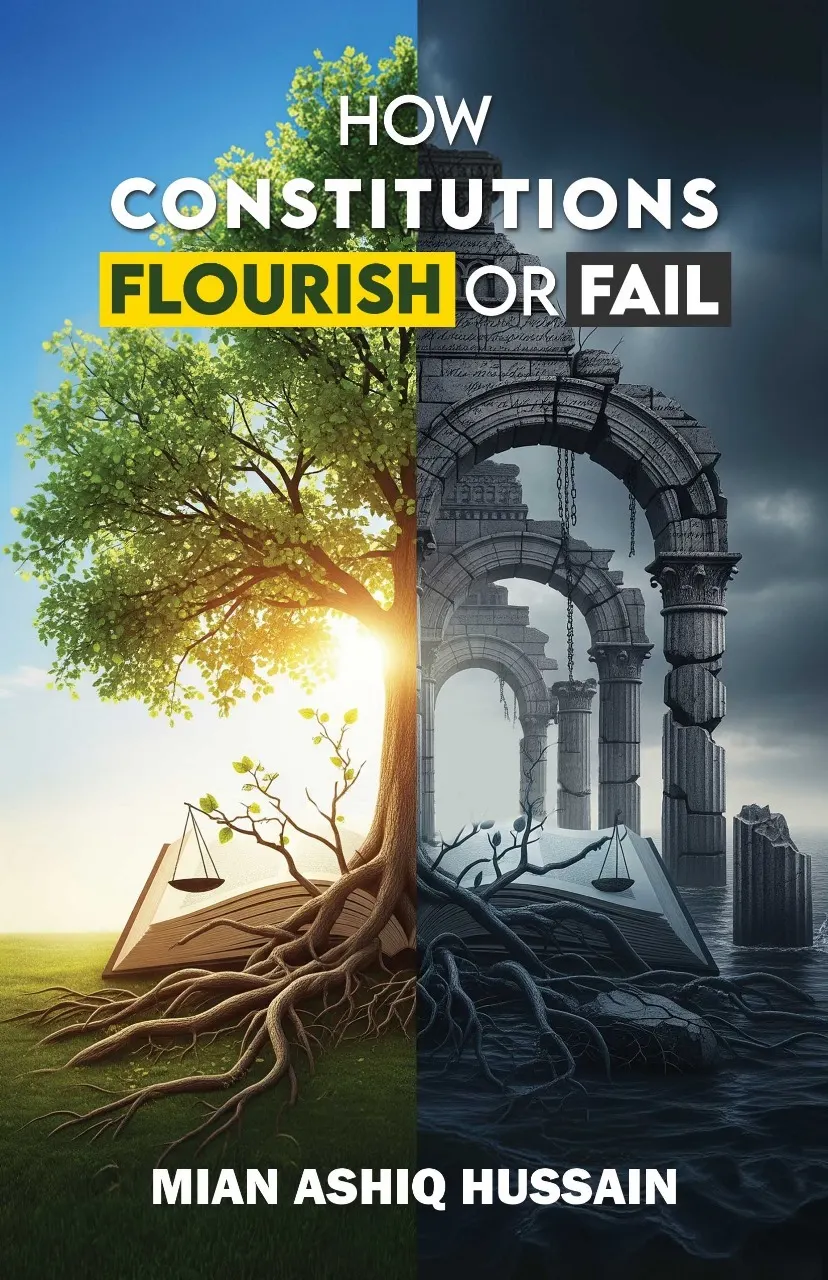
How Constitutions Flourish or Fail
One of the most important questions in modern political and legal studies is why some constitutions survive and others fail. Mian Ashiq Hussain “ How Constitutions Flourish or Fail ” is a thoughtful and engaging study on the development of constitutions, democratic institutions and the factors that affect the successful governance systems around the world.
- Format
- Paperback
- ISBN
- 978-969-7493-41-8
- Publisher
- PaperCraft Publishers


Shipping. Shipped via Trax within 2–4 days across Pakistan; 7–14 days to the UK, USA, UAE & Canada. Printed books can't be returned unless damaged (exchange only); see our Returns Policy.
About this book
This is a must read for students, legal practitioners, researchers, policymakers and anyone interested in the study of the constitution. This insightful work is published by PaperCraft Publishers. The book examines how constitutions evolve over time, the challenges they encounter, and the political, social, and institutional conditions required for them to function effectively. Product Details Title: How Constitutions Flourish or Fail Author: Mian Ashiq Hussain Publisher: PaperCraft Publishers Format: Paperback Category: Law ISBN: 978-969-7493-41-8 How Constitutions Succeed or Fail Why Read? Constitutions are not just legal documents, they are the foundation of a country’s political and legal system. How Constitutions Flourish or Fail provides a more nuanced view of how constitutional systems function and why some manage to stay afloat while others are struggling to survive. The book provides a balanced discussion of constitutional design, institutional development, democratic accountability, and legal reform. The author provides some valuable insights into the relationship between constitutional governance and national progress with detailed analysis and real-world examples. This book is informative and relevant from both a practical and academic perspective, whether you are studying law, political science or public administration. A Useful Resource for the Study of Constitutions This is one of the most insightful books on constitutional law, looking at the principles that underlie constitutional success and the problems that often lead to constitutional failure. It underscores the need for robust institutions, public participation, judicial autonomy and good governance. The book’s broad approach to understanding the influence of constitutions on public administration, political stability and democratic development will be appreciated by those interested in governance and public policy. It is written in a clear and accessible style which makes complex legal concepts more easily understood. Pakistan Constitution Book A Must Read This is a good title for readers in search of a reliable Pakistan constitution book. This book provides meaningful analysis of constitutional issues in national and international contexts. It assists readers in grasping the constitutional development, legal structures and governance issues that are still influencing contemporary states. The book also stimulates thinking critically about constitutional reforms and democratic institutions. Thus, the book becomes a very useful book for students preparing for competitive examinations and academic research. A Book on Comparative Politics That Makes You Think How Constitutions Flourish or Fail has much to offer as a comparative politics book, as well as its value as a book on constitutional analysis. Through the prism of constitutional experiences in different countries the author gives a more complete picture of the functioning of political systems in different historical, cultural and institutional settings. This comparative perspective is useful for the reader when comparing different models of governance and in appreciating the factors that contribute to long-term constitutional stability. Why PaperCraft Publishers? PaperCraft Publishers aims to be a vehicle for distribution of quality academic and professional publications for the purpose of learning, research and intellectual development. The company continues to offer readers valuable resources in law, politics and public affairs with the publication of authoritative works such as How Constitutions Flourish or Fail. If you are looking for one of the most interesting books on constitutional law, a pragmatic book for governance and public policy, a trustworthy Pakistan constitution book, or a well-researched comparative politics book, then this publication is a must-have in your collection. Frequently Asked Questions (FAQs) 1. Who wrote How Constitutions Flourish or Fail? Mian Ashiq Hussain penned How Constitutions Flourish or Fail, showcasing his scholarly perspective on constitutional and political studies. 2. Is How Constitutions Flourish or Fail appropriate for law students? Yes, this book is highly recommended for students of law, researchers, policy makers and all those interested in constitutional studies, governance and political institutions. 3. What makes it one of the best books on constitutional law? The book is a comprehensive treatment of constitutional development, democratic governance, institutional effectiveness and comparative political systems. It is one of the most valuable books on constitutional law available to the academic and professional reader.
Read from this book
- Why Constitutions Fail, and What Makes Them FlourishWhy constitutions fail, from America's Articles of Confederation to Pakistan: Mian Ashiq Hussain argues the answer lies in who controls the power of the purse.
- Why Nations Fail: A Fiscal AnswerWhy nations fail, in Mian Ashiq Hussain's account: states rise when public money answers to the people and fall when revenue, debt and taxation slip out of their control.
- Semi-Presidential Systems: Examples and LessonsSemi-presidential system examples from France and South Korea to Sri Lanka and Taiwan, and why Mian Ashiq Hussain argues the model's time has come for Pakistan.
- Provincial Autonomy in Pakistan: Beyond Legislative ListsProvincial autonomy was Pakistan's founding promise. Mian Ashiq Hussain traces it from the Lahore Resolution through One Unit, 1971 and the 18th Amendment, and argues that legislative lists are not enough without an equal Senate, a working Council of Common Interests, provincial taxes and a provincial say in amendments.
- How Judges Are Appointed: UK, India and Pakistan ComparedHow are judges appointed in the UK, and what can India and Pakistan learn? Mian Ashiq Hussain compares Britain's Judicial Appointments Commission, India's collegium and the fate of the NJAC, and Pakistan's Judicial Commission from the 18th to the 26th Amendment, then outlines a broad-based, merit-driven commission.
- Proportional Representation vs First Past the PostDoes first past the post hand power to minorities? Mian Ashiq Hussain draws on elections in Britain, Weimar Germany and India to argue that proportional representation builds broader, more consensual democracies, takes on the charge of coalition instability, and sets out a mixed system for Pakistan.
- Constitutional Amendments in Pakistan: Who Holds the Pen?Pakistan's Parliament can amend the constitution without the provinces or the people. Mian Ashiq Hussain traces how the 1956 and 1962 constitutions failed, compares the constitutional amendment process in the US, Australia, Canada, Switzerland and India, and argues that a federation's bargain should change only with the consent of those who made it.
- Does Trickle-Down Economics Work? Tax, Inequality, GrowthTax cuts for the rich were meant to lift everyone. Mian Ashiq Hussain argues they widened inequality, and makes the case for fair, progressive taxation instead.
- Local Self-Government: Nordic, Indian and Pakistani LessonsWhy do local councils thrive in Sweden and Finland but keep collapsing in Pakistan? Mian Ashiq Hussain compares local self-government, panchayati raj and Article 140A.
- Fiscal Federalism: Lessons from Five FederationsFederations hold together when each tier can raise what it spends. Mian Ashiq Hussain compares the US, Switzerland, Germany, India and Canada and draws lessons for Pakistan.
- The 18th Amendment in Pakistan: Devolution ComparedThe 18th Amendment moved subjects between lists but left money and power largely at the centre. Mian Ashiq Hussain explains why devolution in Pakistan is unfinished.
- The NFC Award and How Federations Share RevenuePakistan's NFC Award decides how federal tax collections are split between the Centre and the provinces. Mian Ashiq Hussain compares the arrangement with Australia, Canada and India and argues that sharing out a central pool keeps provinces dependent: a working federation also gives each tier taxes of its own.
- The Basic Structure Doctrine: India, Germany and PakistanCan a court strike down a constitutional amendment? India says yes, Germany wrote the answer into its Basic Law, and Pakistan has argued about it for decades. Mian Ashiq Hussain sets out the mainstream case for the basic structure doctrine and his own argument that, where a constitution sets no express limit, the final word on amendment belongs to the people and their representatives, not to judges.
- The Key Insight: Fiscal Governance and the Rise and Fall of StatesHistory in perspective reveals that rise and fall of states have correlation with their fiscal and financial governance.
- Constitutional Checks and Balances: ConclusionsSeparation of powers is an antidote to absolute power of any organ of the state.
- Ivory Towers of the Judiciary and ProgressSince a judicial system plays key role in developing steady socio-political system, it may be seen that the performance of a judicial system has positive correlation with the economic development.
- From Bureaucratic Rule to Self-GovernanceLocal self-governance is the key factor for mobilising the population and optimising its productivity.
- The Way Forward: Renewing the Social ContractIn developing democracies, government for the people is still a work in progress.
- The Partition of Bengal and the Inadequacy of RevenuesThe Partition of Bengal in 1905 was another turning point of historic significance.
- The Six Points Formula and Provincial AutonomySix Points Formula of Awami League was essentially a reaction against the inherited colonial financial procedures incorporated in the Constitution of 1962.
- Caretaker Governments: A Constitutional Black HoleInitially, the concept of caretaker government was incorporated in the Revival of Constitution of 1973 Order (RCO), 1985, which was promulged by Gen Zia ul Haq in March of 1985.
- The Financial Procedures of the United Kingdom and Colonial GovernanceThe United Kingdom has no codified constitution. Unlike countries governed by written constitutions, there is no specified constitutional mandate for financial procedure.
- The Historical Role of Financial Governance in Federal EvolutionThe principal factor shaping and reshaping federal structure is the fiscal part of a constitution.
- The Constitution of the People’s Republic of ChinaOver the past four decades, China has worked a great economic miracle.